Gaming UA in 2026: IAP vs. IAA—And Why the Line Between Them Is Disappearing

Gaming UA in 2026: IAP vs. IAA—And Why the Line Between Them Is Disappearing

If you’re running UA for a mobile game in 2026 and you’re still thinking in clean buckets — “we’re an IAP game” or “we’re an IAA game” — you’re already operating on last year’s playbook.

The market has moved. The data is clear. And the strategies that worked in 2023 are actively working against you today.

Let’s get into it.

First, the numbers that matter

Global mobile downloads are flat to declining, while revenue continues to grow — though unevenly across categories. This isn’t a blip. It’s a structural shift.

Over the past few years:

  • Downloads have stagnated or declined in many markets
  • Revenue has remained stable or grown modestly in gaming, and faster in non-gaming apps

Revenue held up. Downloads didn’t.

What does that tell you about UA? When you can’t grow the top of the funnel, you don’t win by buying more installs. You win by extracting more value from every install you do buy.

That changes what good UA looks like — completely.

The geography split most teams are ignoring

The geography split most teams are ignoring

Here’s something that should be on every gaming UA manager’s radar.

Mature markets — especially the US and Western economies — dominate global IAP revenue, contributing roughly one-third or more of total spend globally. These are high-LTV, high-CPI markets: users who pay but cost more to acquire.

Emerging markets tell a different story. Regions like Southeast Asia, Latin America, and parts of EMEA are scaling rapidly—driven more by ad-based monetisation (IAA) than purchases.

This split exists because of purchasing power, platform behavior, and how ad ecosystems are evolving. And it directly impacts how you run UA.

If you’re applying the same monetization logic—and the same UA strategy—across all geos, you’re leaving money behind.

The user you acquire in California and the user you acquire in Vietnam:

  • don’t behave the same
  • don’t monetise the same
  • shouldn’t be acquired the same way

Treating them identically is a budget problem disguised as a targeting problem.

Genre still dictates model — but less than it used to

The conventional wisdom still holds, broadly: hypercasual leans IAA, RPG and strategy lean IAP, casual sits somewhere in the middle.

But the edges are dissolving.

Midcore games are still largely IAP-driven, but pure ad-only models in complex genres are becoming harder to sustain as development and UA costs rise. Even traditionally IAP-heavy genres like Casino are seeing hybrid monetisation emerge.

And here’s the real signal: a minority of games today run fully optimised hybrid monetisation models.

That gap is the opportunity.

Most games haven’t made the shift yet. The studios that figure out hybrid first — within their genre — build an advantage that compounds over time.

But here’s the catch: hybrid isn’t just a monetisation decision. It fundamentally changes what your UA team needs to optimise for.

How your monetisation model should change your entire UA approach

How your monetisation model should change your entire UA approach

This is the part most guides skip—and where the real money is.

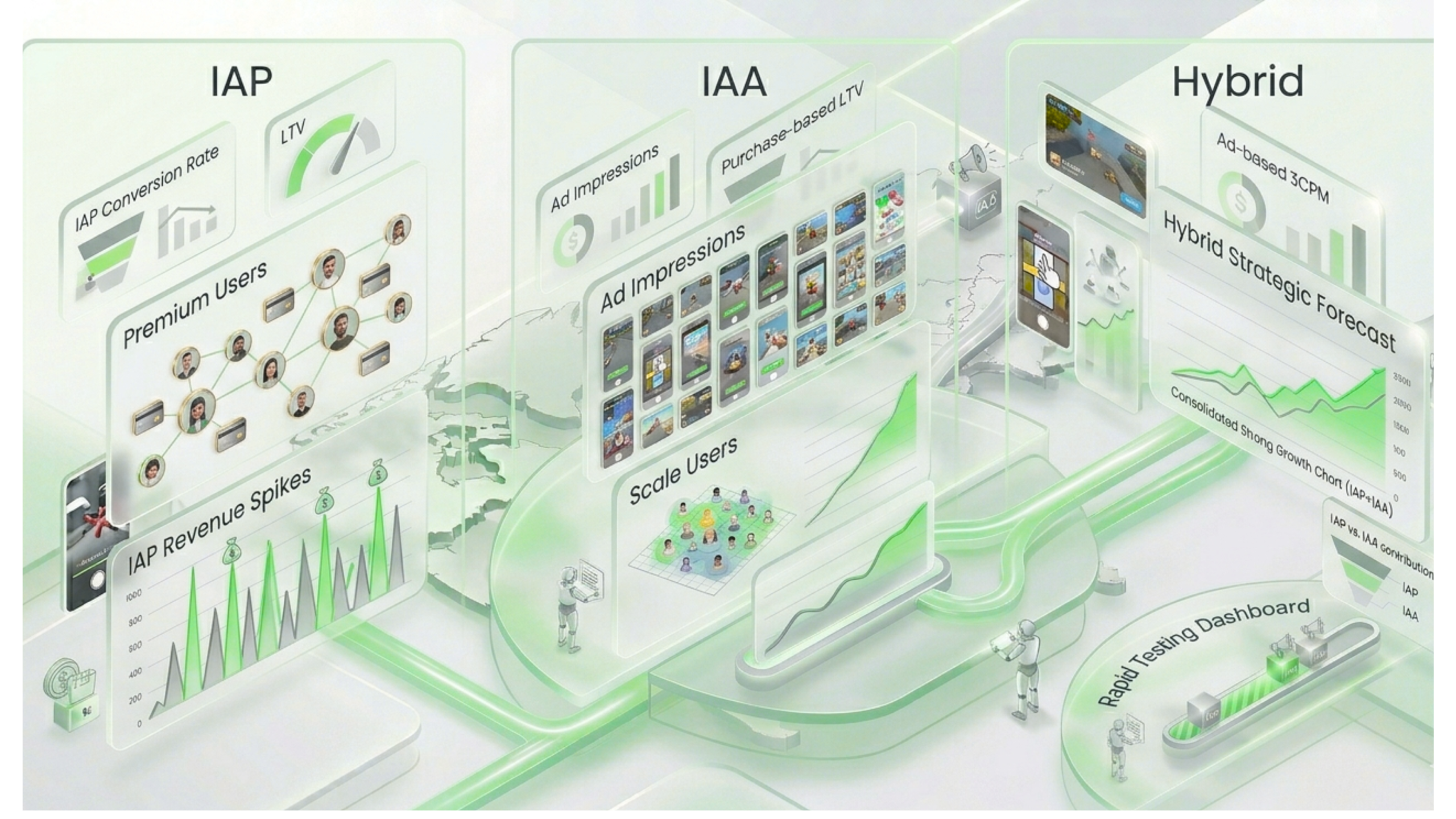
IAP-first games

You’re optimising for a small number of high-value users.

Typically, only ~2–5% of players make purchases, and an even smaller subset drives the majority of revenue.

Your UA job is to find more of them.

That means:

  • deeper post-install signals
  • longer evaluation windows (Day 30+)
  • patience

Cutting campaigns at Day 3 because early ROAS looks weak is one of the most expensive mistakes in IAP UA. Your best users often don’t convert immediately.

IAA-first games

You need volume.

Revenue per user is lower, so your CPI ceiling is tighter. You win on:

  • scale
  • retention
  • session frequency

And one thing becomes critical:

Creative accuracy.

If users don’t get what they were promised, retention drops — and so does revenue per install. The feedback loop is fast and unforgiving.

Hybrid games

This is where most UA teams struggle—because you’re managing two monetisation systems at once.

If you optimise purely for IAP: → you undervalue ad-driven users

If you optimise for installs: → you dilute your high-value audience

The right metric is Total LTV.

IAP revenue + ad revenue, combined at the user level.

Most teams don’t measure this cleanly—which is exactly why the ones who do pull ahead.

The creative arms race has already started — and it’s brutal

The creative arms race has already started — and it’s brutal

Creative production in gaming has scaled aggressively, with top advertisers producing thousands of variations per quarter.

The bottleneck in UA is no longer targeting or bidding — those have largely been commoditised.

The constraint now is:

  • creative velocity
  • testing speed
  • learning cycles

More inventory is entering the auction. Competition is rising.

Generic creative doesn’t survive anymore.

Most UA teams don’t have a targeting problem. They have a production problem.

The non-games disruption gaming UA teams need to understand

Non-gaming apps — especially subscription-based and utility apps — are growing faster in IAP revenue than games, and are increasingly competing for the same high-value users.

These apps have adopted the playbook gaming pioneered:

  • onboarding funnels
  • value demonstration
  • monetisation timing

And in many cases, they benefit from stronger retention models.

The result: gaming studios are no longer just competing with other games — they’re competing across categories for user attention and spend.

What this actually means for UA in 2026

A few principles are becoming non-negotiable:

  • Segment by monetisation model, not just genre
  • Stop measuring hybrid games with single-model metrics
  • Optimise for Total LTV, not just CPI or ROAS
  • Treat geography as a monetisation decision
  • Invest in creative production as a core capability
  • Give IAP campaigns time to mature

The bottom line

The IAP vs IAA debate was never really the point.

It was always about:

  • who your user is
  • how they monetise
  • and where you acquire them

In 2026, the teams that understand this—and build their UA strategy around it—are the ones pulling ahead.

Downloads are flat. CPIs are rising. Competition is intensifying.

The teams that win aren’t buying their way out of that problem.

They’re thinking their way out of it.

Related Blogs

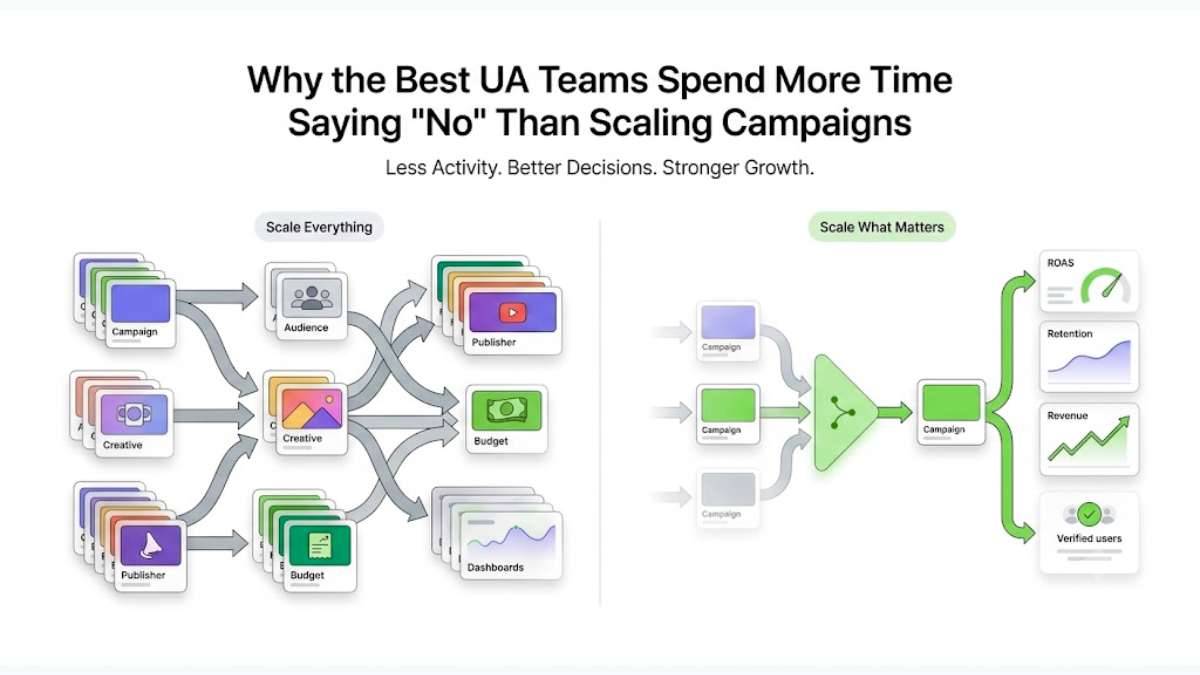
Why the Best UA Teams Spend More Time Saying “No” Than Scaling Campaigns

For years, User Acquisition revolved around one question: How fast can we scale? Bigger budgets. More geographies. More creatives. More installs. Growth meant doing more. But in 2026, the best UA teams are asking a different question:

The FIFA Effect: How We Helped an iGaming Client Turn Peak Demand Into Growth

Every major tournament creates the same paradox for iGaming marketers.

First-Party Data in UA — What It Actually Means Beyond the Buzzword

First-party data has become one of the biggest buzzwords in UA.
APPSHEPHERD

Protect Every Install.

Always-on fraud protection designed to keep your traffic clean and attribution accurate.