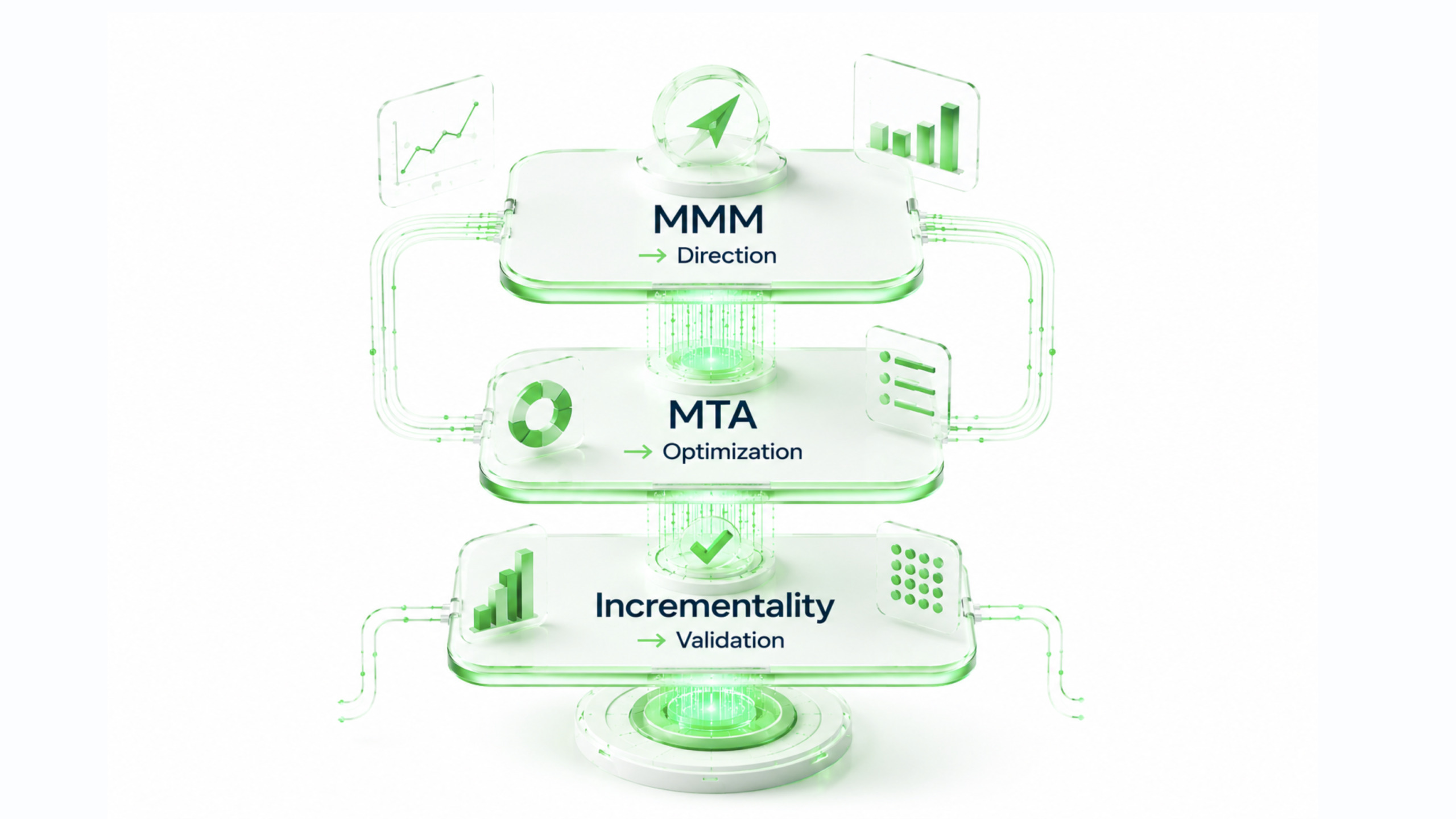
The Measurement Intelligence Stack
The future of measurement isn’t MMM versus MTA versus Incrementality. It’s understanding that each answers a different question.
MMM → Direction. Where should budget go?
MTA → Optimization. What should we change today?
Incrementality → Validation. Did marketing actually cause growth?
Individually, each method provides an incomplete picture. Together, they create a measurement system capable of operating in a privacy-first world.
1. Marketing Mix Modeling (MMM) — The Strategic View
Marketing Mix Modeling uses historical spend and outcome data across channels to estimate their contribution to business results. Unlike attribution, MMM doesn’t rely on user-level identifiers — making it naturally resilient to privacy changes and signal loss.
What it’s good at:
• Understanding channel-level contribution at macro scale
• Evaluating paid, organic, seasonal, and external factors together
• Budget allocation, forecasting, and identifying diminishing returns
What it misses:
• Creative-level insights or real-time feedback
• Fast decision cycles — it operates on weeks or months of data
MMM is an excellent tool for answering strategic questions. It’s not designed to tell a media buyer which campaign to adjust tomorrow morning.
2. Multi-Touch Attribution (MTA) — The Path View
MTA attempts to assign conversion credit across the touchpoints that influence a user’s journey. Before ATT, this provided a highly detailed view of performance. Today, much of that journey — particularly on iOS — has become partially invisible.
Despite those limitations, MTA remains critical for operational decision-making.
What it’s good at:
• Campaign-level optimization and creative analysis
• Audience-level performance insights
• Faster decision cycles
What it misses:
• Significant portions of iOS behavior
• True causal impact — it attributes, it doesn’t prove
• Channels that influence without leaving a traceable footprint
MTA remains valuable. It should no longer be treated as the complete source of truth.
3. Incrementality Testing — The Ground Truth
Would this conversion have happened if the marketing activity never existed?
Through geo holdouts, audience exclusions, ghost bidding, and lift studies, marketers can isolate the actual causal impact of advertising — not modeled, not attributed, but measured.
What it’s good at:
• Measuring true lift
• Validating — or invalidating — what attribution reports claim
• Exposing channels that receive credit without generating growth
What it misses:
• Continuous, always-on measurement across every channel
• Granular creative or placement-level signal
Incrementality isn’t designed to replace attribution. It’s designed to challenge it.
Why None of Them Work Alone
This is where many teams make a costly mistake. They choose one framework, build reporting around it, and treat its outputs as absolute truth.
• MMM shows a channel contributing significantly to long-term growth — but offers no guidance on which creative to rotate out this week.
• MTA credits a retargeting partner with 40% of conversions. Incrementality testing reveals half of those users would have converted anyway.
• Incrementality proves a channel generates lift — but can’t tell you which audience segment or placement is driving it.
Each framework has different strengths, different blind spots, and different dependencies on available data.
Using them together isn’t a luxury anymore. It’s a requirement.