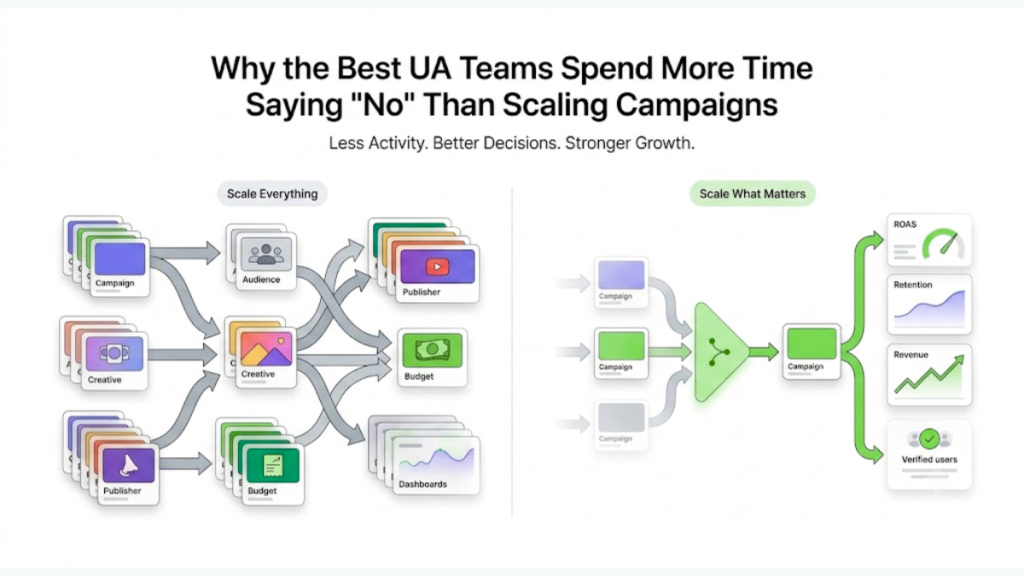

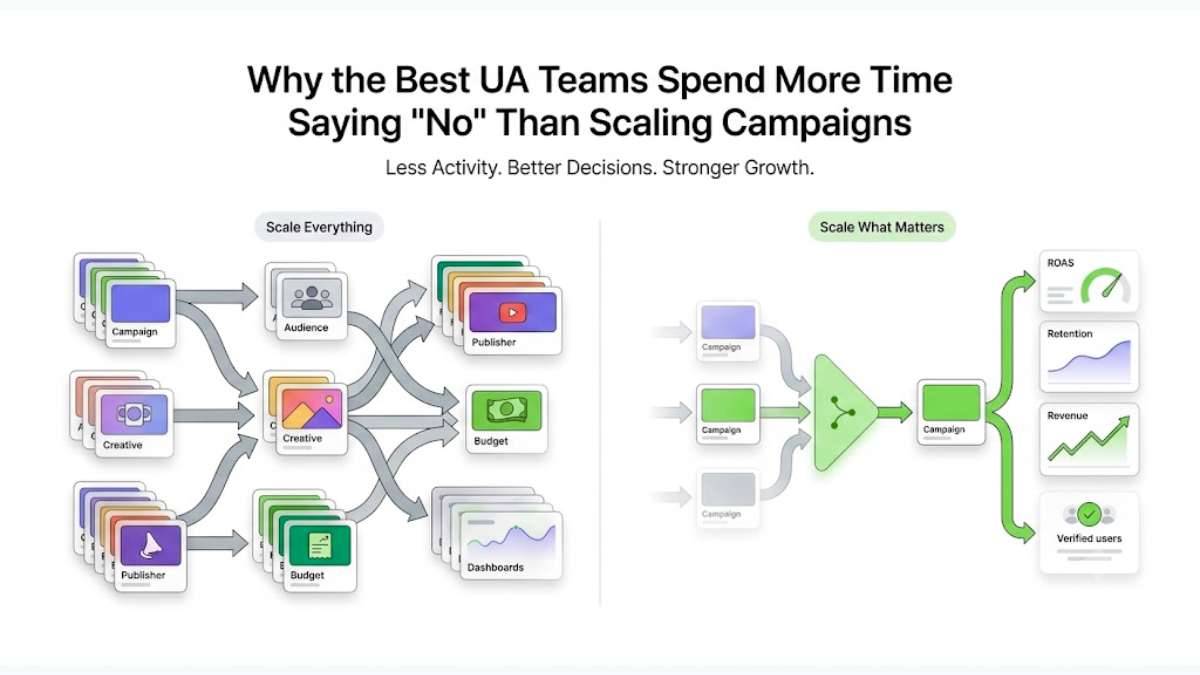
Why the Best UA Teams Spend More Time Saying “No” Than Scaling Campaigns

Why the Best UA Teams Spend More Time Saying “No” Than Scaling Campaigns

For years, User Acquisition revolved around one question:

How fast can we scale?

Bigger budgets. More geographies. More creatives. More installs.

Growth meant doing more.

But in 2026, the best UA teams are asking a different question:

What deserves to be scaled at all?

The highest-performing teams aren’t growing faster because they’re more aggressive. They’re growing more efficiently because they’ve learned that disciplined decisions outperform endless expansion.

The bottleneck has moved. Many teams are still optimizing for the old one.
The Bottleneck Isn't Launching Anymore

Launching campaigns has never been easier.

AI automates bidding. Creative production is faster. Campaign setup takes minutes instead of days.

That used to be the hard part. It isn’t anymore.

The real challenge today is deciding which campaigns deserve to exist in the first place.

Every new audience, creative, publisher, or optimization experiment competes for the same attention, budget, and learning capacity. Every additional variable makes it harder to understand what’s actually driving performance.

Sometimes the fastest way to improve results isn’t launching another campaign.

It’s removing one.

Every "Yes" Has a Hidden Cost

Most teams evaluate a new campaign on its upside. Fewer calculate what saying yes costs elsewhere.

Every additional campaign can mean:

  • Splitting conversion data across more campaigns, weakening the learning signal in each
  • Stretching creative resources for marginal incremental gains
  • Adding reporting complexity that makes attribution harder to trust
  • Creating overlapping audiences that quietly compete against one another
  • Spending more time managing campaigns than learning from them

None of these costs show up on a dashboard. Eventually, all of them show up in performance.

The best UA teams protect focus just as carefully as they protect budget.

No #1: Saying No to Your Own Campaigns

No #1: Saying No to Your Own Campaigns

The first “no” is internal. It’s the discipline to pause — or kill — a campaign that looks successful on the surface, because the metrics driving a scale decision are often the same ones hiding the biggest risks.

  • Install volume looks healthy while D30 retention quietly declines
  • CPI improves while traffic quality deteriorates
  • ROAS looks strong overall but is being carried by a single geo or one creative close to fatigue

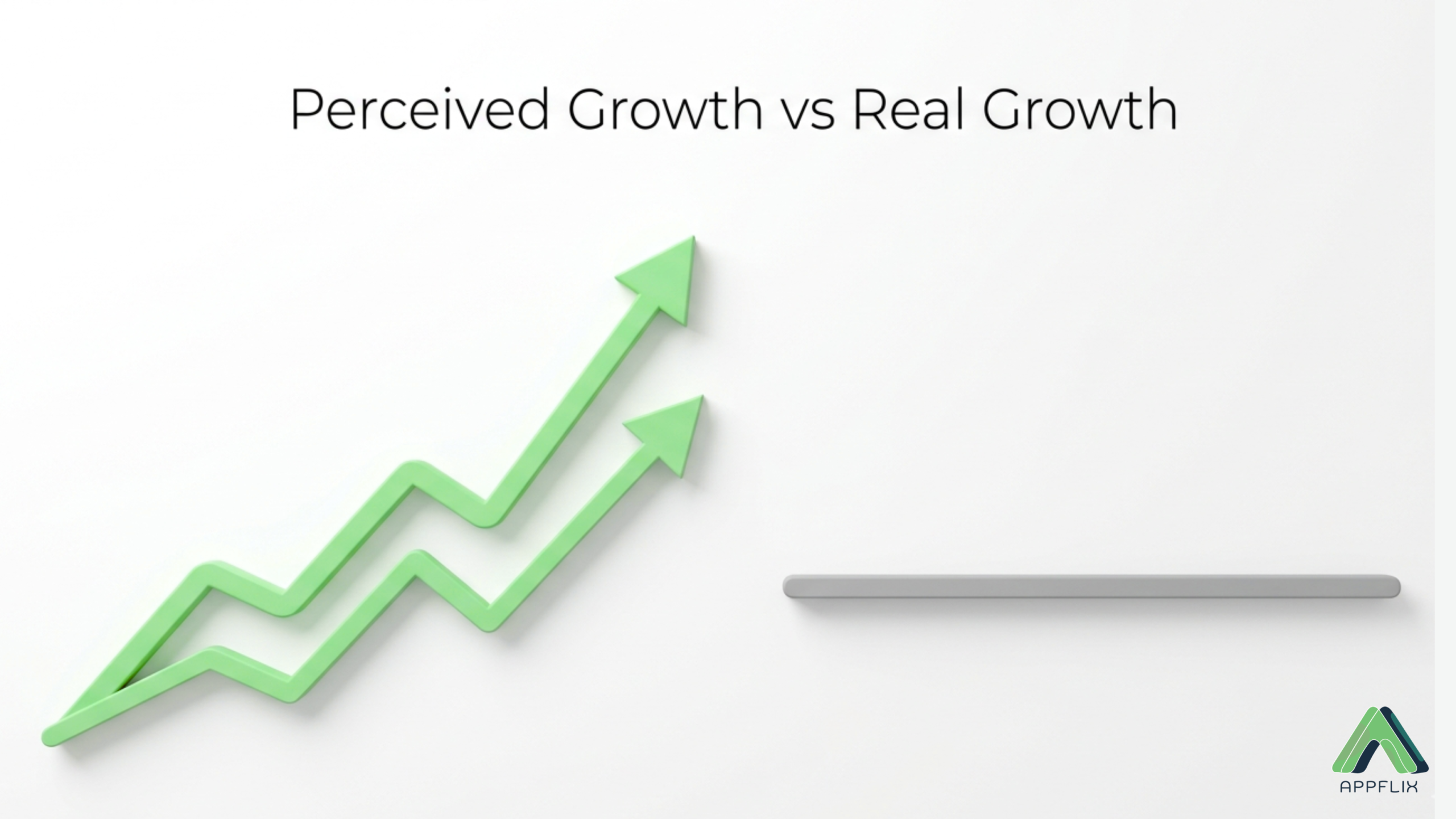
iThis is also where early momentum gets mistaken for evidence. A campaign performs well for a few days. Budget increases. New publishers get added. More markets go live.

Then performance falls apart — not because scaling was wrong, but because confidence arrived before validation.

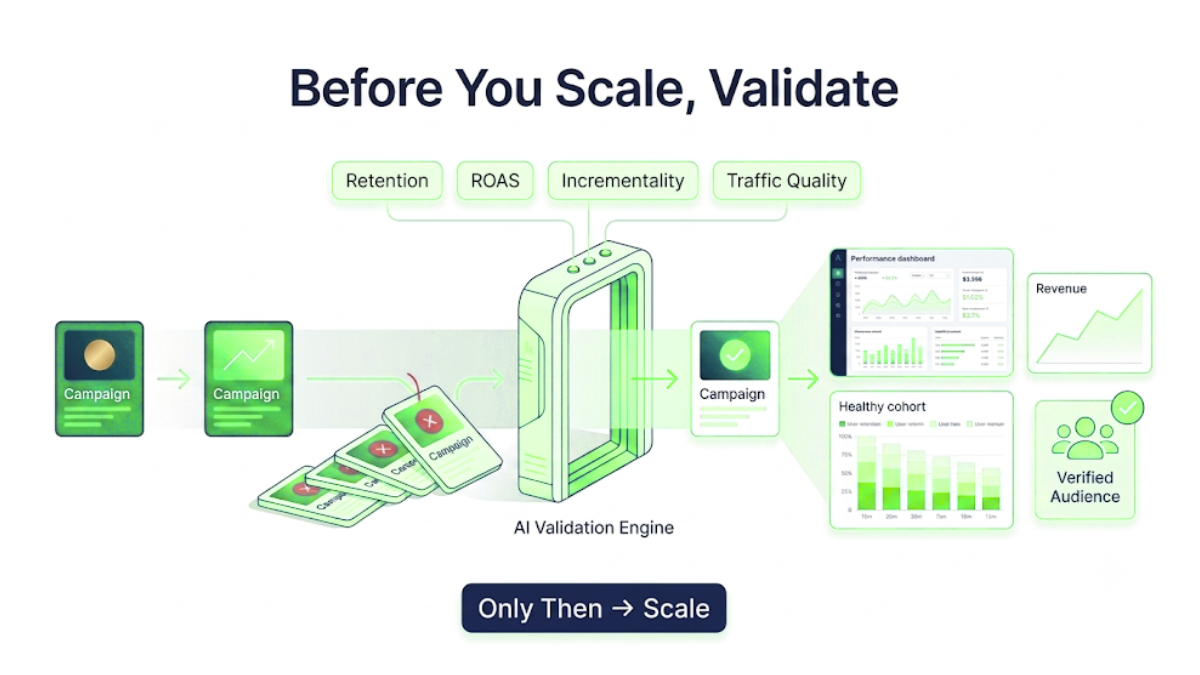
Before increasing spend, the sharper questions are:

  • Is this statistically meaningful, or a small sample behaving like one?
  • Are we improving retention — or just installs?
  • Are we generating incremental users, or paying for conversions that would have happened anyway?

If those answers aren’t clear, waiting isn’t hesitation. It’s the decision.

No #2: Saying No to "Just Scale It"

The second “no” is external — pushing back when a client, founder, or exec wants to double spend because last week’s numbers looked promising.

That excitement is usually understandable. But experienced UA teams know a great week doesn’t always become a great quarter. Scaling too early often exhausts your highest-intent audience before you’ve built a durable acquisition engine around it. And once expectations are built around temporary performance, they’re much harder to reset later.

The best teams don’t ask stakeholders to trust the process. They show the evidence — comparing what happens if you scale today versus after another two weeks of validated cohort data, and walking through the likely impact on CPI, retention, and long-term ROAS.

That’s not slowing growth down. That’s protecting it.

What Every "No" Protects

Every disciplined decision protects the same three things.

Capital. Every dollar not spent scaling a campaign about to break becomes budget available for the one that actually compounds.

Signal quality. Ending weak experiments early keeps attribution cleaner and makes the next optimization more reliable.

Trust. A client told “not yet” — and later shown why — has far more confidence in the next recommendation to scale. A client never told no starts discounting every number they’re shown.

Saying no doesn’t reduce momentum. It builds the leverage that makes the next yes count.

Build a Decision Framework, Not an Instinct

The strongest UA teams don’t rely on gut feel alone. They build repeatable frameworks for when to launch, scale, pause, or stop — so the question in the room stops being “Can we scale this?” and becomes:

  • Should we?
  • Why now?
  • What evidence supports this?
  • What are we giving up by saying yes?

Those questions catch expensive mistakes long before a dashboard reveals them.

The Real Skill Isn't Restraint. It's Judgment.

This isn’t an argument for being conservative. Plenty of campaigns deserve fast, aggressive scaling.

The real skill is knowing which signals deserve confidence — and having the discipline to act on that distinction even when everyone in the room wants to accelerate.

Anyone can launch another campaign. Technology has made sure of that. Far fewer teams know when not to.

That discipline is what protects budgets, preserves signal quality, and builds the trust that makes every future “scale it” mean something.

The strongest UA teams aren’t remembered for how aggressively they scaled. They’re remembered for the campaigns they refused to.

Because in modern User Acquisition, judgment compounds faster than budget.

Related Blogs

Why the Best UA Teams Spend More Time Saying “No” Than Scaling Campaigns

For years, User Acquisition revolved around one question: How fast can we scale? Bigger budgets. More geographies. More creatives. More installs. Growth meant doing more. But in 2026, the best UA teams are asking a different question:

The FIFA Effect: How We Helped an iGaming Client Turn Peak Demand Into Growth

Every major tournament creates the same paradox for iGaming marketers.

First-Party Data in UA — What It Actually Means Beyond the Buzzword

First-party data has become one of the biggest buzzwords in UA.
APPSHEPHERD

Protect Every Install.

Always-on fraud protection designed to keep your traffic clean and attribution accurate.