Q4 Isn’t One Season: Rethinking Mobile Growth in the Most Competitive Quarter of the Year

Q4 Isn’t One Season: Rethinking Mobile Growth in the Most Competitive Quarter of the Year

Q4 is not a single growth opportunity. It is a sequence of moments, each with different levels of demand, competition, cost and user intent. The brands that win aren’t necessarily the ones that spend the most. They’re the ones that know when, where and why to spend.

Q4 Has a Reputation Problem

Every Q4, the pattern is familiar.

Competition intensifies. Seasonal demand shifts. Brands reallocate budgets. Teams prepare new creatives. And as the biggest commercial moments approach, one question starts coming up more often:

How much more should we spend?

But that may be the wrong question.

The better question is:

Where does growth actually become more valuable during Q4?

Because Q4 isn’t one season.

It is a collection of demand cycles, competitive environments and moments of user intent compressed into three months. October does not necessarily behave like November. Black Friday does not represent the same opportunity as Christmas. And the value of users acquired in December may extend well beyond December itself.

The data supports the broader point.

AppsFlyer’s 2026 India Festive Report shows that festive demand does not peak uniformly across categories. In its analysis of India’s 2025 festive window, Shopping’s biggest week came before Diwali, while Finance’s biggest week followed it. The report analyzed 2.1 billion installs, 5 billion remarketing conversions and $700 million in user acquisition and remarketing spend across seven verticals.

The 2025 edition of the same report had already described India’s festive season as a nine-week sequence of performance opportunities rather than a single Diwali peak.

The implication is simple:

Q4 should be managed as a portfolio of opportunities, not as one expensive quarter.

The Q4 Paradox

Rising competition does not automatically make acquisition less attractive.

It makes undisciplined acquisition less attractive.

When advertiser demand increases, the economics of acquiring attention can change. Appodeal’s Q4 2024 mobile advertising data, for example, showed eCPMs increasing from October through December, with December recording the highest eCPMs across the ad formats it studied. That is evidence of stronger advertising demand in its dataset—but it should not be confused with a universal increase in CPI or CPA across every UA campaign.

That distinction matters.

Because cost is only one side of the Q4 equation.

The other side is intent.

A user acquired during a major shopping event may behave differently from a user acquired during a post-holiday period. A user responding to a limited-time promotion may have a different conversion path from one acquired through an evergreen proposition.

The same media cost can therefore produce very different outcomes depending on:

  • when the campaign runs,
  • who it reaches,
  • what the creative communicates,
  • what action the user takes,
  • and what happens after the acquisition event.

That is where the real Q4 advantage sits.

Why the Blended Number Can Mislead

Why the Blended Number Can Mislead

Here’s the uncomfortable part:

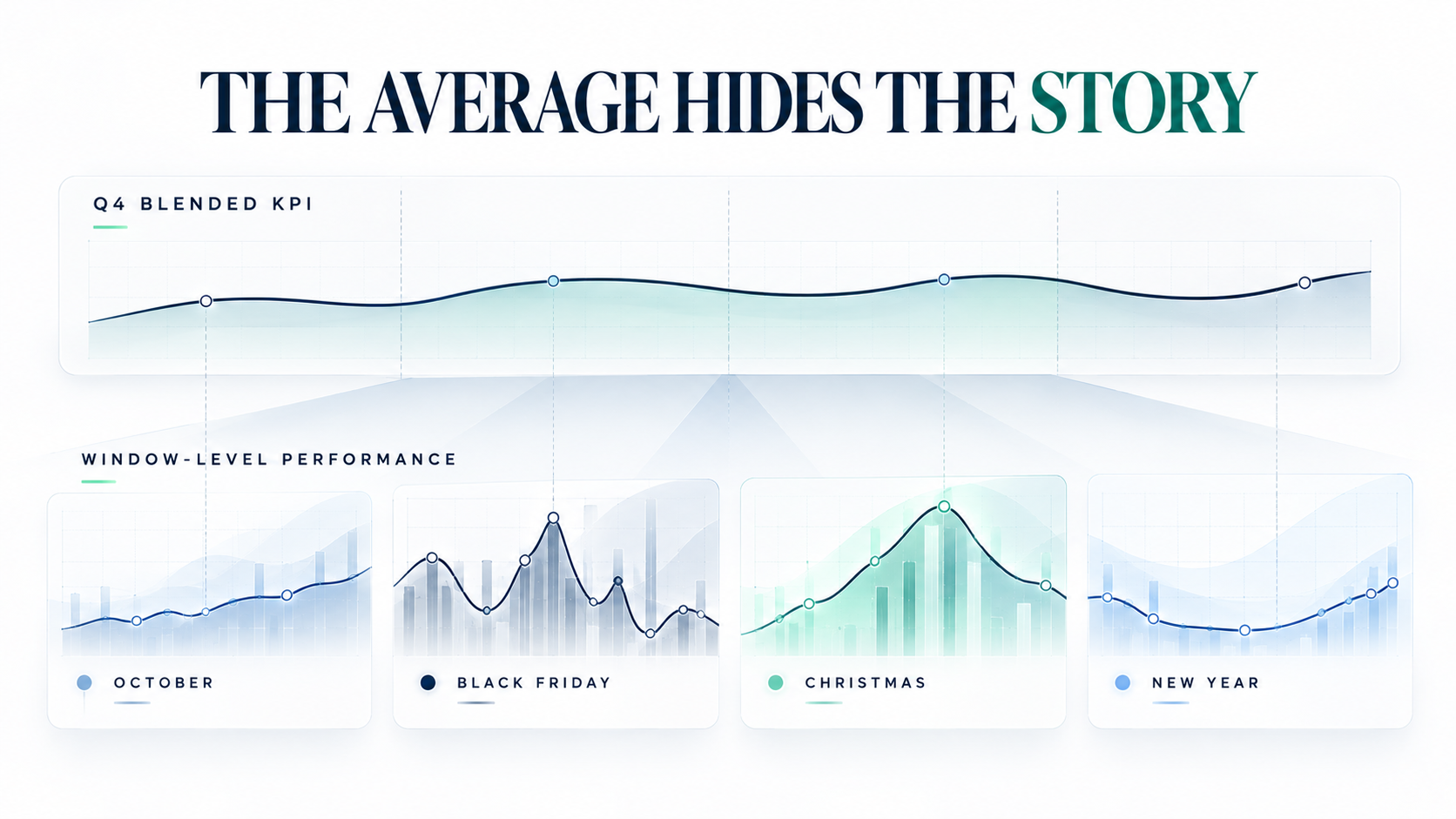
Q4 can look perfectly healthy on average while individual windows are telling a very different story.

A blended CPI can combine a relatively stable October with a highly competitive November.

A blended ROAS can combine high-intent users from one period with lower-value cohorts from another.

The average itself isn’t wrong.

It is simply answering a less useful question.

Instead of asking only:

“How did Q4 perform?”

ask:

“Which windows created value, which windows consumed value, and why?”

That means breaking the quarter into meaningful operating stages.

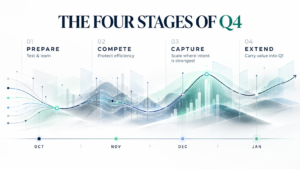
At Appflix, we think about Q4 through four:

Prepare → Compete → Capture → Extend
01 — Prepare

October is not necessarily the month to maximize volume.

It is the month to reduce uncertainty.

This is where growth teams can:

  • establish pre-season benchmarks,
  • identify promising audiences,
  • validate creative concepts,
  • test landing experiences,
  • audit measurement,
  • review fraud controls,
  • and understand which channels have room to scale.

The goal is not maximum volume.

It is maximum learning before the most competitive periods arrive.

The principle is simple:

Test. Learn. Refine. Scale.

Not:

Launch. Hope. Spend more.

A creative concept that has already demonstrated quality before peak competition gives a team a very different starting position from one that is being tested for the first time when media costs and pressure are highest.


02 — Compete

As major commercial events approach, competition can intensify—particularly in markets where events such as Black Friday and Cyber Monday are significant.

This is where blindly increasing spend becomes dangerous.

A campaign that performs well at one level of investment does not automatically remain efficient at a much higher level.

So Q4 requires more than monitoring CPI or CPA.

Ask:

  • Are conversion rates holding?
  • Is downstream quality holding?
  • Are users reaching the events that actually matter?
  • Is revenue keeping pace with acquisition cost?
  • Are we finding incremental users, or simply buying more users we might have reached anyway?

The larger the budget, the more expensive a weak signal becomes.

If tracking is incomplete, more spend does not solve the problem.

If fraud controls are weak, more volume does not solve the problem.

If creative coverage is thin, more impressions do not solve the problem.

If the funnel leaks, more traffic simply sends more users through the leak.

Scaling doesn’t fix a weak system. It amplifies it.


03 — Capture

This is where the idea of a single “Q4 peak” becomes especially misleading.

Different markets and categories can have different high-value windows.

Recent holiday data illustrates this clearly.

Admiral Media’s September 2026 analysis, drawing on Moloco’s 2025 holiday data, reported that US gaming saw stronger ROAS around Christmas and New Year even though competition and costs had peaked earlier. In that dataset, the Christmas-to-New-Year period delivered a 32% ROAS increase on iOS and a 15% increase on Android compared with the start of Q4.

The lesson is not that Christmas is always the best time to advertise.

The lesson is that the most expensive period and the most valuable period do not have to be the same period.

That changes how budgets should be planned.

Instead of:

“Q4 is expensive, so we should spend less.”

Think:

“Where does the relationship between cost, intent, conversion quality and value become most attractive?”

That is a much better scaling question.


04 — Extend

December 31 is not a reset button.

Users acquired during Q4 can continue to generate value in Q1 through retention, re-engagement, remarketing and monetization.

AppsFlyer’s India festive research provides a useful example. Its 2025 analysis found that activity continued after the Diwali peak, with Gaming and Food & Drink apps recording post-peak install growth of 29% and 16%, respectively.

Its 2026 India Festive Report similarly emphasizes that different categories reach important moments at different points across the festive window, including post-Diwali opportunities.

So instead of asking only:

“How many users did we acquire?”

ask:

“What did those users become?”

An install is an acquisition event.

It is not necessarily a business outcome.

There Is No Universal Q4

There Is No Universal Q4

For brands operating across multiple markets, the complexity compounds.

There is no single global Q4 calendar.

India has its own festive cycle. The US has a major Thanksgiving-to-Black-Friday-to-Christmas sequence. Other markets have their own cultural, commercial and seasonal moments.

Even within a single country, different verticals can peak at different times.

AppsFlyer’s 2026 India data makes this particularly clear: Shopping’s strongest week occurred before Diwali, while Finance’s strongest week came afterward.

That means a global calendar saying:

October = Test
November = Scale
December = Peak

is too simple.

A more useful decision framework is:

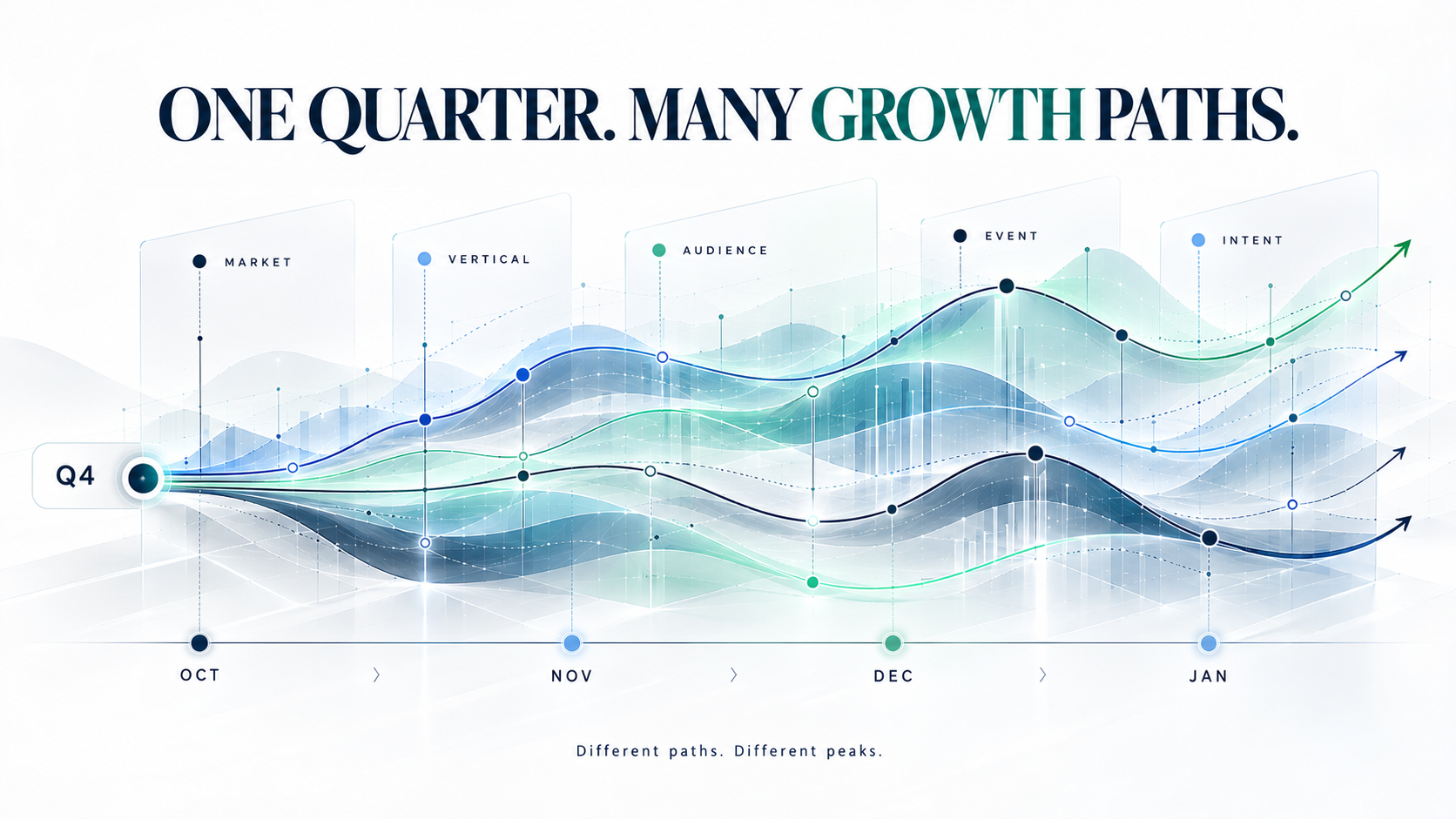
Market × Vertical × Audience × Event × Intent

One market may still be in a testing window while another is already scaling.

One category may be approaching its highest-intent period while another is preparing for a later opportunity.

Global growth requires local timing.

Don't Make Everything a Holiday Ad

Another Q4 habit is almost unavoidable:

Suddenly, everything becomes seasonal.

Countdowns.

Discount badges.

Festive colors.

Holiday references.

Limited-time messaging.

But seasonal does not automatically mean effective.

The stronger approach is to seasonalize the context without abandoning the proposition that already works.

If a creative concept consistently drives quality conversions, don’t throw it away simply because November arrived.

Adapt it.

Change the context.

Change the offer where appropriate.

Change the visual environment.

Change the urgency.

Change the audience angle.

But preserve the reason the concept works in the first place.

The strongest Q4 creative system is therefore not:

Evergreen creatives → delete → holiday creatives.

It is:

Evergreen winners + seasonal variations + new experiments.

That creates more options without throwing away the learning accumulated before Q4.

Design Q4 Backwards From the Outcome

The biggest shift in Q4 thinking is moving from calendar-first to outcome-first.

Instead of:

“Black Friday is coming. Let’s increase the budget.”

Ask:

“What outcome are we trying to create in this window, and what level of investment can create it efficiently?”

Instead of:

“December is expensive.”

Ask:

“Where does higher cost still produce higher-value users?”

Instead of:

“The campaign delivered strong ROAS.”

Ask:

“How much of that growth was actually incremental?”

Q4 can make performance numbers look impressive simply because consumer demand is already changing.

That is why cohort-level quality and incrementality matter.

A campaign can report strong attributed performance without proving that every attributed conversion was caused by the additional media spend.

The bigger the budget, the more important that distinction becomes.

The Real Q4 KPI Isn't Spend

It is decision quality.

A strong Q4 team isn’t necessarily the one with the biggest budget.

It is the team that can answer:

Why are we increasing spend?

Why this market?

Why this audience?

Why this channel?

Why this creative?

Why now?

And equally importantly:

When should we stop?

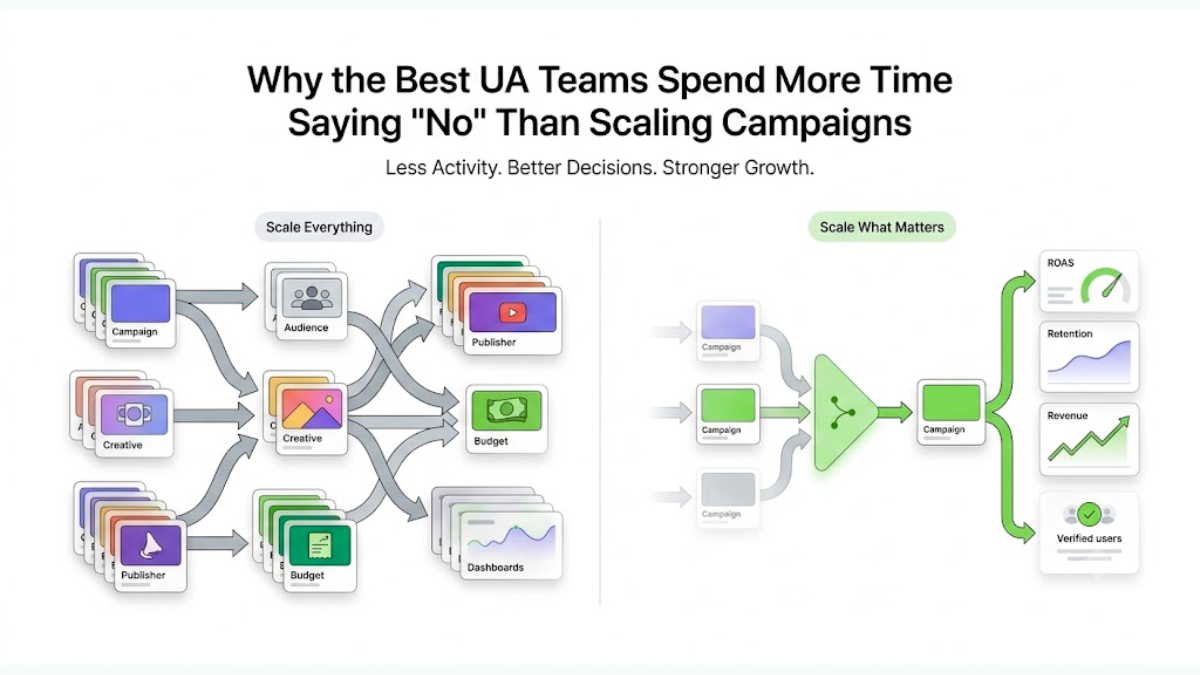
That ability to say no becomes increasingly valuable when competition is high.

No to a campaign that looks good on CPI but fails downstream.

No to a channel that scales without demonstrating incremental value.

No to a creative that has exhausted its audience.

No to spending simply because everyone else is spending.

Discipline becomes a competitive advantage when everyone else is chasing volume.

Five Questions to Answer Before the Squeeze

If you’re planning Q4, the most valuable work may happen before the peak.

Before competition intensifies, be able to answer:

1. What are our KPIs for each stage of Q4—not just for the quarter?

A single quarterly target can hide meaningful differences between acquisition windows.

2. Which creative concepts are tested, and which still need to be?

Know what has evidence behind it before the most competitive periods arrive.

3. Where are we relying on a lagging signal that could mislead us under pressure?

Not every important business outcome appears immediately after acquisition.

4. What thresholds trigger a budget shift, and who owns that call?

Decide the guardrails before emotions and urgency enter the equation.

5. What’s our plan for January?

Q4 acquisition should not be disconnected from Q1 retention, re-engagement and monetization.

If you can answer these questions now, Q4 becomes a series of decisions you’ve already prepared for.

If you can’t, Q4 becomes the quarter that happens to you.

The Advantage Isn't Being First. It's Being Ready.

Every brand knows Q4 matters.

Every advertiser knows competition can increase.

Every growth team knows budgets may need to move.

That knowledge alone isn’t an advantage.

The advantage is knowing what to do when the market changes.

It is building a system that can recognize when the opportunity shifts—and respond without losing sight of quality.

Because Q4 isn’t one season.

It is a sequence of moments.

A sequence of auctions.

A sequence of user intentions.

A sequence of decisions.

And ultimately, a sequence of opportunities to create growth.

The brands that win won’t necessarily have the biggest budgets.

They’ll have the clearest signals, the strongest measurement, the strongest creative discipline, and the confidence to scale when the data says go—and stop when it says no.

At Appflix Media, that’s how we think about performance growth: not as a race to acquire more users, but as a discipline of finding and scaling the right users, through the right signals, at the right moment.

Because in Q4, growth isn’t about spending more.
It’s about making every decision count more.


Related Blogs

Q4 Isn’t One Season: Rethinking Mobile Growth in the Most Competitive Quarter of the Year

Q4 is not a single growth opportunity. It is a sequence of moments, each with different levels of demand, competition, cost and user intent. The brands that win aren’t necessarily the ones that spend the most. They’re the ones that know when, where and why to spend.

The App Attention War: Why Getting Noticed Is Becoming Harder Than Getting Installed

There was a time when the install was the hard part. Right audience. Right ad. They clicked. They installed. Job done. Not anymore.

Why the Best UA Teams Spend More Time Saying “No” Than Scaling Campaigns

For years, User Acquisition revolved around one question: How fast can we scale? Bigger budgets. More geographies. More creatives. More installs. Growth meant doing more. But in 2026, the best UA teams are asking a different question:
APPSHEPHERD

Protect Every Install.

Always-on fraud protection designed to keep your traffic clean and attribution accurate.