Why the Blended Number Can Mislead
Here’s the uncomfortable part:
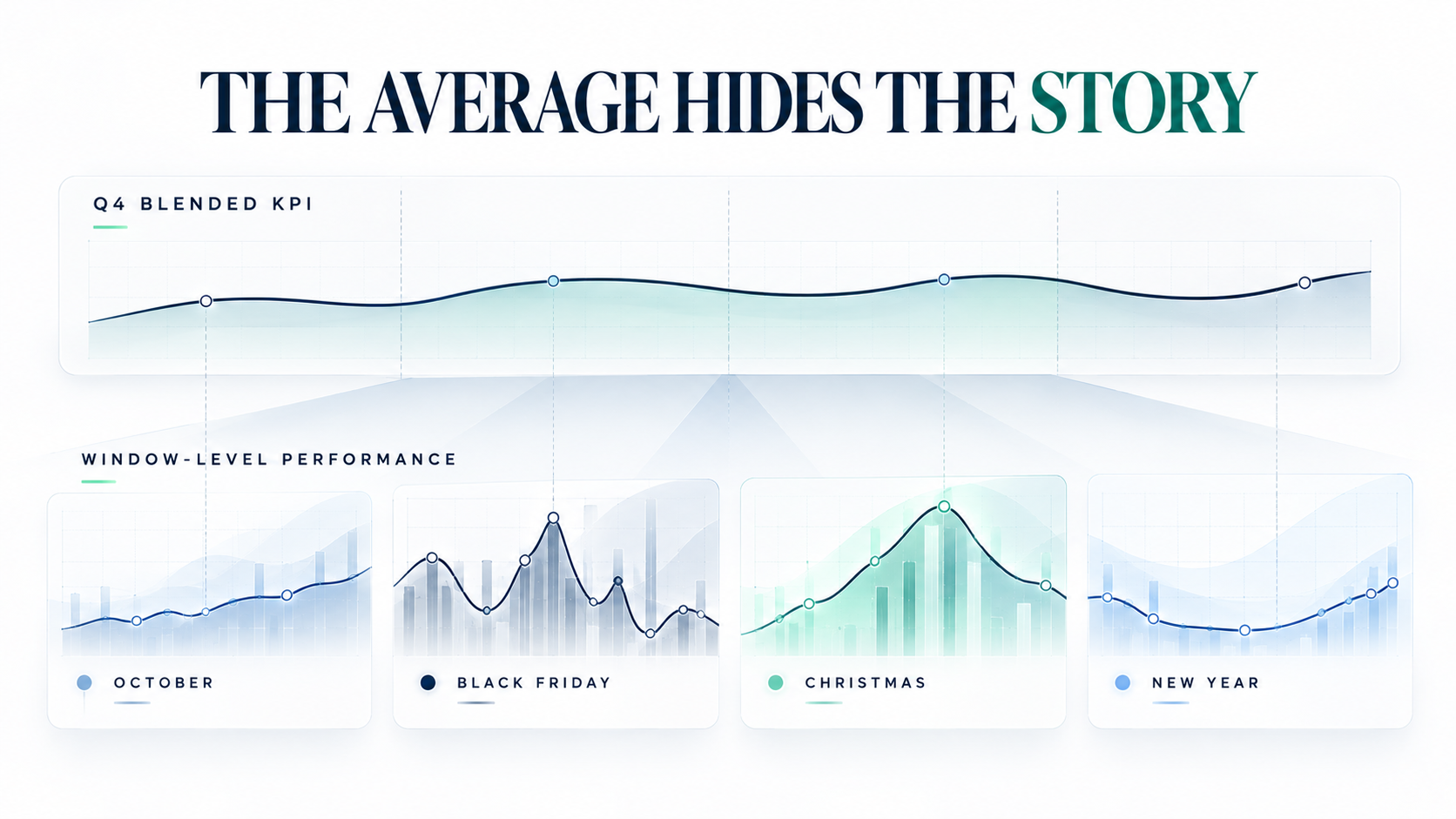
Q4 can look perfectly healthy on average while individual windows are telling a very different story.
A blended CPI can combine a relatively stable October with a highly competitive November.
A blended ROAS can combine high-intent users from one period with lower-value cohorts from another.
The average itself isn’t wrong.
It is simply answering a less useful question.
Instead of asking only:
“How did Q4 perform?”
ask:
“Which windows created value, which windows consumed value, and why?”
That means breaking the quarter into meaningful operating stages.
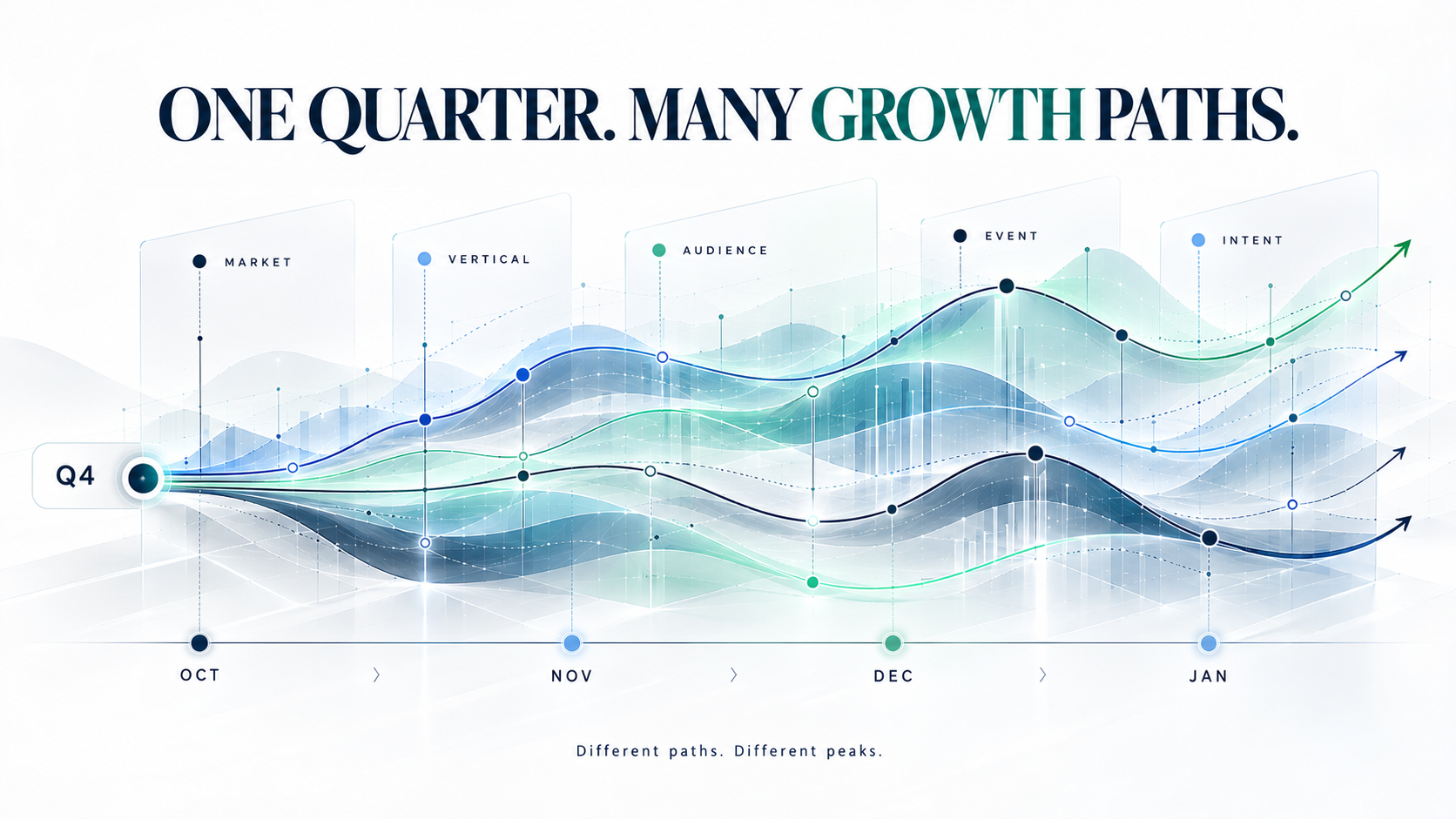
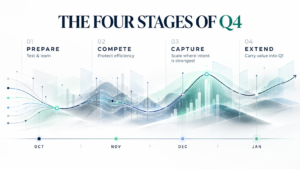
At Appflix, we think about Q4 through four:
Prepare → Compete → Capture → Extend
01 — Prepare
October is not necessarily the month to maximize volume.
It is the month to reduce uncertainty.
This is where growth teams can:
- establish pre-season benchmarks,
- identify promising audiences,
- validate creative concepts,
- test landing experiences,
- audit measurement,
- review fraud controls,
- and understand which channels have room to scale.
The goal is not maximum volume.
It is maximum learning before the most competitive periods arrive.
The principle is simple:
Test. Learn. Refine. Scale.
Not:
Launch. Hope. Spend more.
A creative concept that has already demonstrated quality before peak competition gives a team a very different starting position from one that is being tested for the first time when media costs and pressure are highest.
02 — Compete
As major commercial events approach, competition can intensify—particularly in markets where events such as Black Friday and Cyber Monday are significant.
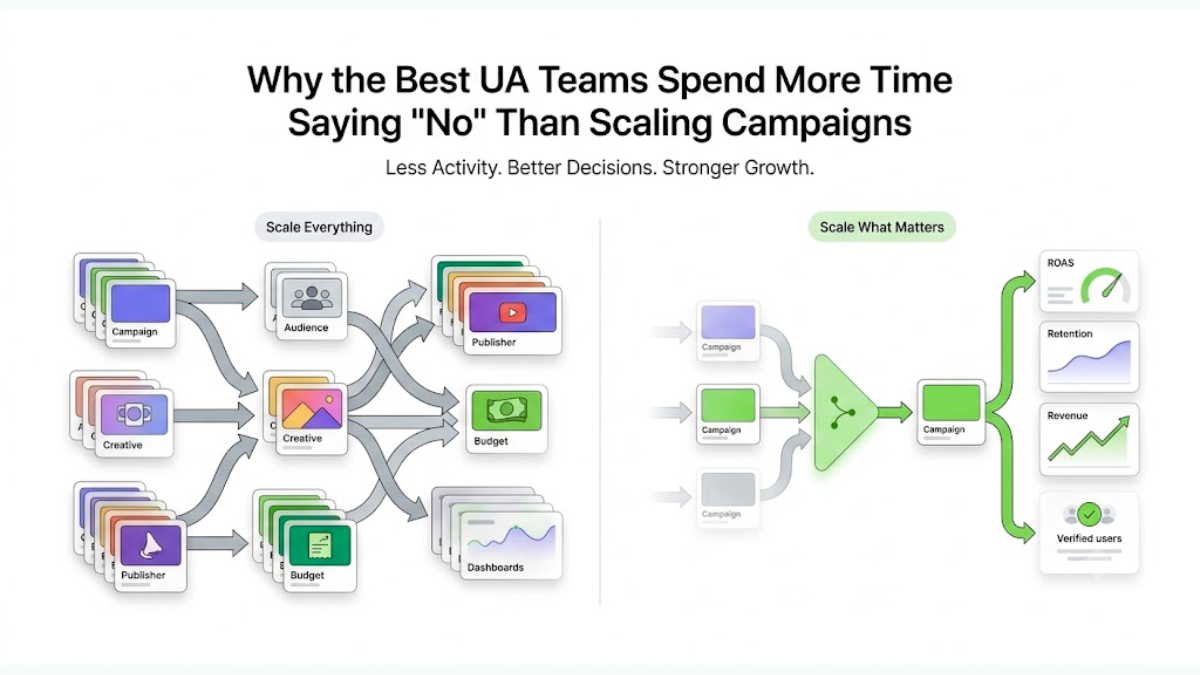
This is where blindly increasing spend becomes dangerous.
A campaign that performs well at one level of investment does not automatically remain efficient at a much higher level.
So Q4 requires more than monitoring CPI or CPA.
Ask:
- Are conversion rates holding?
- Is downstream quality holding?
- Are users reaching the events that actually matter?
- Is revenue keeping pace with acquisition cost?
- Are we finding incremental users, or simply buying more users we might have reached anyway?
The larger the budget, the more expensive a weak signal becomes.
If tracking is incomplete, more spend does not solve the problem.
If fraud controls are weak, more volume does not solve the problem.
If creative coverage is thin, more impressions do not solve the problem.
If the funnel leaks, more traffic simply sends more users through the leak.
Scaling doesn’t fix a weak system. It amplifies it.
03 — Capture
This is where the idea of a single “Q4 peak” becomes especially misleading.
Different markets and categories can have different high-value windows.
Recent holiday data illustrates this clearly.
Admiral Media’s September 2026 analysis, drawing on Moloco’s 2025 holiday data, reported that US gaming saw stronger ROAS around Christmas and New Year even though competition and costs had peaked earlier. In that dataset, the Christmas-to-New-Year period delivered a 32% ROAS increase on iOS and a 15% increase on Android compared with the start of Q4.
The lesson is not that Christmas is always the best time to advertise.
The lesson is that the most expensive period and the most valuable period do not have to be the same period.
That changes how budgets should be planned.
Instead of:
“Q4 is expensive, so we should spend less.”
Think:
“Where does the relationship between cost, intent, conversion quality and value become most attractive?”
That is a much better scaling question.
04 — Extend
December 31 is not a reset button.
Users acquired during Q4 can continue to generate value in Q1 through retention, re-engagement, remarketing and monetization.
AppsFlyer’s India festive research provides a useful example. Its 2025 analysis found that activity continued after the Diwali peak, with Gaming and Food & Drink apps recording post-peak install growth of 29% and 16%, respectively.
Its 2026 India Festive Report similarly emphasizes that different categories reach important moments at different points across the festive window, including post-Diwali opportunities.
So instead of asking only:
“How many users did we acquire?”
ask:
“What did those users become?”
An install is an acquisition event.
It is not necessarily a business outcome.